When your air conditioning fails unexpectedly during Orlando's intense heat, every hour without cooling puts comfort and safety at risk. Our emergency AC repair focuses on rapid, accurate diagnosis to restore cooling as efficiently as possible.
Not every AC issue is an emergency, but some symptoms warrant prompt evaluation. These conditions can affect safety, cause water damage, or indicate a failure that worsens with continued operation.
The system runs but delivers no cooling, or does not start at all. Possible causes include compressor failure, a failed capacitor, loss of refrigerant charge, or control-board problems.
A burning smell from the indoor unit, outdoor unit, or vents may indicate an overheating motor, melting wire insulation, or a failing electrical component. Turn off the system immediately.
A breaker protecting the AC circuit trips to prevent overcurrent. Repeated tripping may indicate a grounded compressor, shorted wiring, or a failing motor drawing excess amperage.
Water pooling around the air handler or dripping from the ceiling near indoor equipment may indicate a blocked drain line, cracked drain pan, failed condensate pump, or a frozen coil thawing.
Ice forming on indoor coils or refrigerant lines suggests restricted airflow, a refrigerant problem, a failing blower, or a metering device issue. Continued operation can damage the compressor.
Sudden grinding, screeching, or banging from the outdoor unit or air handler may indicate a seized bearing, broken fan blade, or failing compressor component. Shut down the system to prevent further damage.
An emergency cooling failure requires focused, systematic diagnosis rather than guesswork. When we arrive for an urgent AC evaluation, we begin by gathering information about the symptoms — when the problem started, what the system was doing before the failure, any sounds or odors observed, and whether any changes were made to the thermostat or breaker.
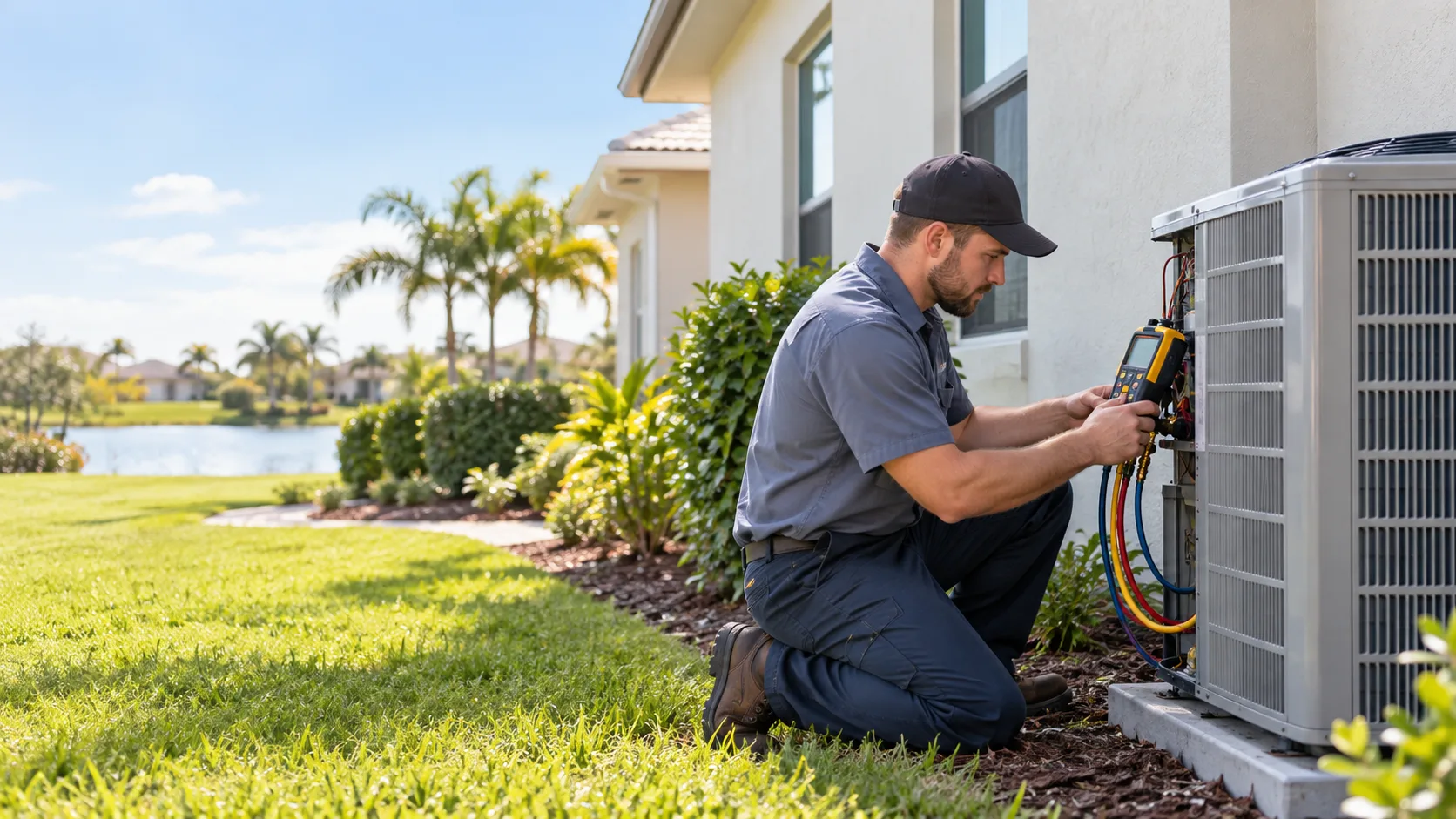
From there, we test the electrical system first. We verify voltage at the disconnect, check capacitor values, test contactor operation, measure motor amperage, and evaluate the compressor's electrical condition. Refrigerant indicators are checked only when relevant — we do not add refrigerant without first identifying the cause of any charge loss.
Airflow, condensate conditions, thermostat communication, and control-board signals are also part of the evaluation. Many no-cool situations in Orlando involve clogged condensate drains triggering the float switch, failed capacitors unable to start the compressor or fan, or thermostat/control issues that prevent the system from communicating properly. As part of our Orlando air conditioning services, we identify the specific failure before recommending any repair action.
Orlando's summer heat and electrical stress accelerate capacitor degradation. A failed run capacitor can prevent the compressor from starting, leaving the system blowing warm air.
Central Florida's humidity generates heavy condensation. Algae, slime, and debris clog the drain line, triggering the safety float switch and shutting the system down entirely.
Afternoon thunderstorms are a regular occurrence in Orlando. Lightning-related power events can damage capacitors, contactors, control boards, and surge protectors.
A locked rotor, open winding, or grounded compressor typically requires major repair or replacement. These failures often cause the breaker to trip or the system to hum without starting.
While waiting for professional evaluation, these safe steps can help protect your equipment and provide useful information for the technician.
Dealing with a no-cool emergency, electrical issue, water leak, or frozen coil? Contact us now to discuss your situation and arrange a diagnostic evaluation.
